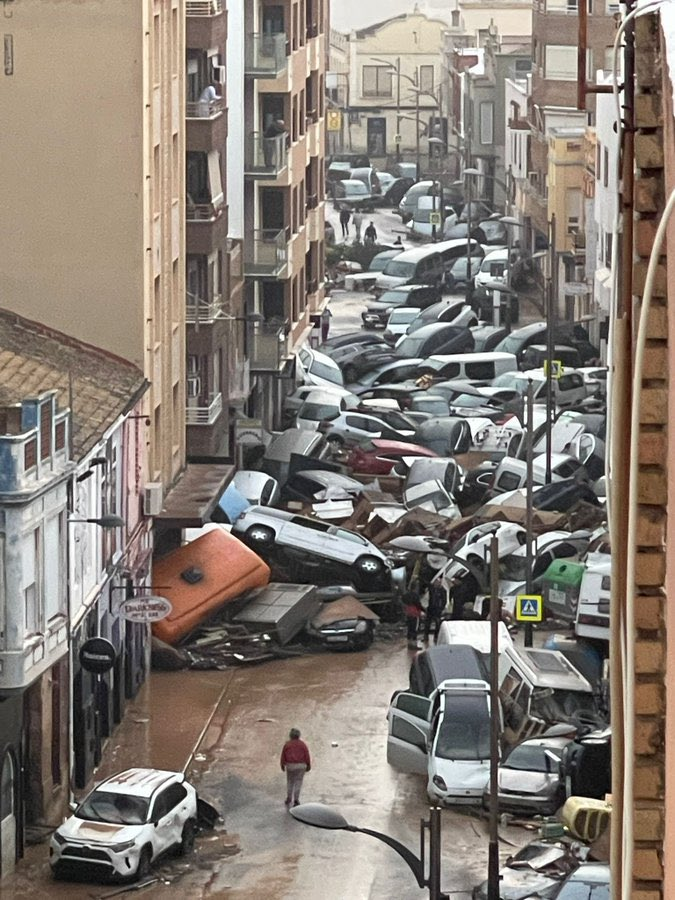
The Spanish government declared three days of official mourning on Friday after the number of confirmed deaths from flash floods in Valencia and surrounding provinces rose to 72.
Parts of Valencia, Albacete and Cuenca were inundated within hours by exceptionally heavy rainfall of more than 400 litres per square metre.
TV footage showed the worst downpour since September 1966. The streets became rivers; cars were washed away, and riverbanks burst. A bridge over the River Magro was submerged.
Scores of people trapped inside their vehicles. Fears grow for scores of elderly residents living in single-storey homes who may be unable to get out.
Over 60 roads were closed, including various main highways along the eastern coast and roads linking Madrid to Valencia. Regional train services were brought to a standstill, as were high-speed rail links with the capital.
Prime Minister Pedro Sanchez declared he would go through the affected regions on Thursday. He called an emergency cabinet meeting this morning and came up with a formal declaration in the middle of this day.
“Our absolute priority is to help you,” Sanchez said after promising all the support his government can give to flood victims. He underlined that all means were coordinated for assistance.
King Felipe VI expressed his “sadness and regret” due to the tragedy. President of the European Commission Ursula von der Leyen said the EU activated the Copernicus satellite system in order to support rescue coordination.
European Council President Charles Michel said: “The EU is ready to do more to help”. The country has deployed around 1,000 members of the Spanish Military’s Emergency Response Unit, which goes by the name UME to support rescue and cleaning operations.
Operations across affected areas are facing hitches due to power cuts and the breakdown in telephone networks.
Pilar Bernabe, the Spanish government delegate for Valencia, urged citizens to avoid dangerous roads in Valencia and Castellon. “There are still people trapped and we need to support the emergency services,” she said.
Meteorologists linked the torrential rain to an “isolated high-altitude depression,” or DANA, which occurs when a cold air front meets warm Mediterranean waters. Similar incidents caused catastrophic flooding in 1966 and 1957.