
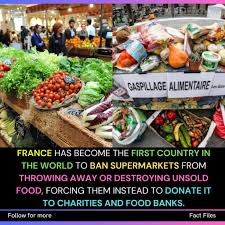
France has become a global trailblazer in combating food waste and hunger by legally requiring supermarkets to donate unsold yet edible food to those in need. Since 2016, this groundbreaking law has transformed how grocery stores handle surplus food, with violators facing fines of up to $4,500 (Ksh. 650,000) per infraction.

A LAW FOR CHANGE
Introduced in 2016, the legislation compels supermarkets to establish formal agreements with charities to donate their unsold food items. Jacques Bailet, president of Banques Alimentaires—a prominent network of food banks in France—described the significance of this law at its inception:
“Supermarkets are now obligated to partner with charities, improving the quality and variety of food we distribute. This law allows us to address critical gaps, particularly in providing more meat, fruits, and vegetables,” Bailet said.
HOW IT WORKS
Over 9,000 supermarkets across France participate in this initiative. Volunteers collect a range of items, including yogurt, pizza, fresh produce, and cheese, directly from stores. These goods are loaded into vans and transported to food banks, churches, and community centers.
From there, the food is distributed to families in need through a vast network of over 5,000 charities. This systematic approach ensures efficiency in reducing waste and addressing food insecurity.
IMPACT OF THE LAW
Nearly two years after its implementation, the law has significantly increased both the volume and quality of food donations. Guillaume Garot, the parliamentarian behind the legislation, highlighted its success:
“It’s changed the supermarkets’ practices. They’re more mindful of their environment and are giving more,” Garot explained.
Today, nearly half of the food distributed by French food banks comes from supermarket donations—a testament to the law’s effectiveness.
A MODEL FOR THE WORLD
This initiative not only reduces food waste but also addresses malnutrition and supports vulnerable families. France’s innovative law serves as an inspiring model for countries worldwide, showcasing how legislation can foster a culture of responsibility and compassion among businesses.